Rococo Infinity
In June 2024, I performed in Rome with fellow artists from the Superpang label. During the stay, I managed to visit the Vatican for the first time in over twenty years. When I was younger and immersed in minimalism, I think I viewed these works—functioning in part as propaganda for religious authority—with a certain cold distance. But with age, that stance had dissolved. This time, I could simply look, carried by curiosity and surprise.
In the Gallery of Maps in particular, I was captivated by its overwhelming ornamentation. A free and continuous metamorphosis: an angel’s foot turning into a bird’s wing, the wing mutating into tentacle-like limbs, and those limbs gradually blending into plant tendrils that ascend into clouds drifting across the ceiling. At first glance, it appears graceful, but the mutations are profoundly strange, giving the entire ceiling a sense of motion. The density of information leaves the eye no place to rest. Craftsmen actually clung to this ceiling, painting all of this with their lives on the line? I was completely absorbed. Is this what one calls Rococo? Since this is Italy, perhaps an early form of it? I felt as if my perception were being caught in a web of information strung across the ceiling. I took notes on my phone:
Excess
Surprisingly grotesque
A web
Deleuzian
Rococo ∞
*
I later realized, however, that this had been a misunderstanding on my part. The Vatican’s ornamentation is not classified as Rococo in art-historical terms. Rococo emerged in eighteenth-century France, and both its ornamental vocabulary and cultural background belong to a distinctly French context. In contrast, the Gallery of Maps, the Sistine Chapel, and the Raphael Rooms were all created in Rome during the fifteenth and sixteenth centuries, and stylistically belong to the Renaissance, late Mannerism, or the early Baroque.
*
I have often returned to Kenjiro Okazaki’s The Conditions of Renaissance Experience. In it, Okazaki describes Brunelleschi with a distinctive sense of humor, saying that he possessed an intellect so extraordinary it would paralyze an ordinary human brain—far surpassing even Dr. Lecter from Thomas Harris’s Hannibal. After Rome, we were heading to Florence, and I wanted to spend as much time as possible seeking out the architecture and artworks produced by that monstrous intellect. Standing before the frescoes of the Brancacci Chapel, I even wanted to test whether the dizziness said to accompany encounters with truly great works of art—the so-called Stendhal syndrome—might happen to me as well.
Florence is a small city, and within a few days I was able to see almost everything I had hoped to. It was wonderful to be able to look at the architecture and art from the book at my own pace. Yet, strangely, the very works I thought I had already “understood” through reading became things I ended up responding to with my head rather than with my senses when I finally stood before them. Perhaps because I was relying on the book—thinking through someone else’s mind—the Stendhal syndrome never came to me. Preoccupied with checking what I had read against what I was seeing, I may have thinned the impact my own feelings and body should have received.
What remained with me, however, was the impression of the Vatican’s ornamentation, along with the phrase “Rococo ∞,” which I had typed into my phone even though it was art-historically inaccurate. It had come out of a bodily reaction. I kept noticing free, fluid shifts in ornament and elements in which parts seemed to spread evenly into the whole. In Michelangelo’s library, for instance, I felt less drawn to the illusionistic architecture at the entrance than to the grotesque animal motifs inside—the goats on the ceiling and other figures whose patterns pulled my attention. Even in the frames and door moldings of the hotel, I found myself looking for the same sensation.
*
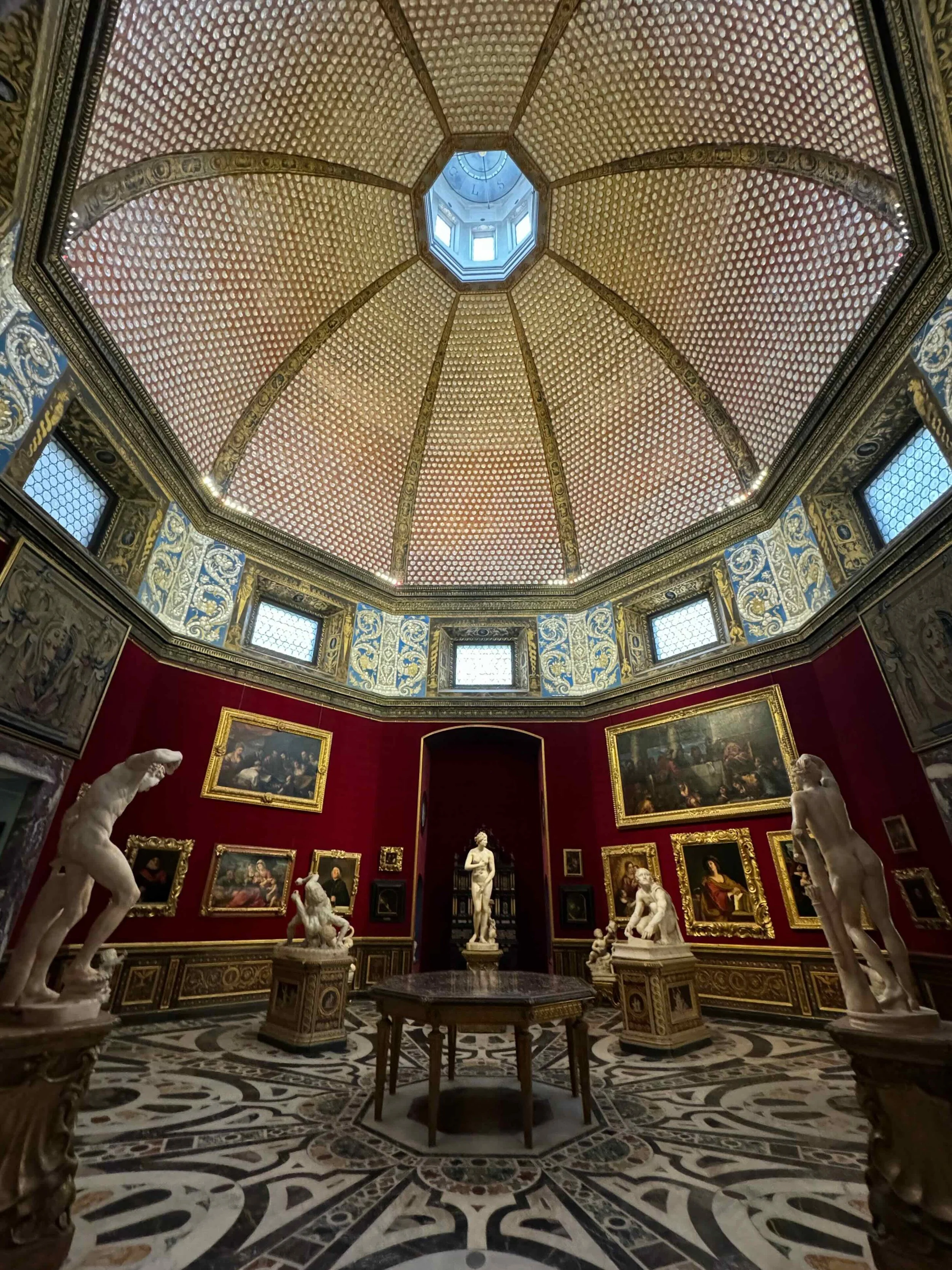
The smaller corridor of the Uffizi had an intimacy that felt almost like the long hallway of a private home. It was early and almost empty, and I walked alone, looking up at the ceiling paintings. The galleries were impressive, but I felt more at ease walking the corridor lined with sculptures and sunlight than standing before “great” works kept under strict protection and artificial lighting. As I went on, I came to a room with a particularly strong presence: the Tribuna. I must have visited it more than twenty years ago, but I had no memory of it. Feeling slightly tense, I stepped into the octagonal room.
Under the canopy, a white goddess stands before me. Thousands of mother-of-pearl shells spread across the ceiling, casting a soft glow over the space. As I took in the scene—the nacreous sheen, the sense of endless rocaille—I felt a stirring I couldn’t quite name. Shells, rocaille… Wait, is this what Rococo is? Whether it was art-historically accurate no longer mattered. It even felt as if my memory had gone ahead and brought me here so it could be retrieved. Looking around the room, what came to me was not inspiration but something more direct—almost a physical urge.
I want to stack huge speakers in here and blast noise from synthesizers and drum machines!
Maybe it was the shift—from all those grand spaces I’d been seeing across Italy to a scale that felt almost like a private room—that pushed my thinking in a different direction. Or maybe it was the white Venus standing in that soft, shell-reflected light that set something off. In the empty Tribuna that morning, the sound image rose all at once.
The ultimate music for the Tribuna must be noise. I start picturing it. Just me and Akita-san—my Prophet-6 bending pitch to the edge, pushing out warped analog noise, his massive mid-highs coming in over it. The way the ornament keeps generating and mutating—at that accelerating pace, the beat and sub-bass fuse hard and punch straight through. I imagine a huge analog reel-to-reel machine set in the center of the room, playing drones from viola and cello. In the blast of noise, they get cut up and come out in fragments.
As I imagined those cut-off lines of instruments layered with noise, Godard’s severed editing style crossed my mind. Cut-up, soft voices. Not singing. Words spoken by a woman, somewhere between poetry and everyday speech. Anne Wiazemsky. For Godard, her voice must have been anti-gravity against the violence. The noise shaking the room bends gently along the curves of the Venus sculpture. One vortex splits off and connects to another. And then a voice comes in, cutting through all of it. The words blur the boundaries between the vortices, and new patterns start to form again.... I typed a short note into my phone:
Noise
Rococo ∞
Me & Merzbow
Godard cuts
Voice
Japanese
無限大のRococo
2024年6月、Superpang のレーベルメイトと、ローマでライブイベントを行った。滞在の合間を縫ってヴァチカンを訪れた。最後に来たのは二十年以上前だ。ミニマリズムに傾倒していた当時の若い僕は、宗教権威のプロパガンダとしての機能をもつこれら一連のアートに、どこか冷めた目を向けていたと思う。しかし歳を重ねて、今回は余計な構えもなく、純粋な興味と驚きのままに作品をみることができた。とくに地図の間ではその過剰なほどの装飾に釘付けになった。自由な変幻(メタモルフォーゼ)―天使の足が鳥の羽になりその羽はタコのような足になり、それは次第に植物のつたと同化して空を舞う雲へつながっていく。一見優美だが、きわめて奇妙な変異が、天井全体に動きを与えている。視線が休まらないほどの情報量。これを職人たちが命懸けで天井に張り付いて描き続けたのか。僕は完全に引き込まれていた。こういうのをRococoというのだろうか。ここはイタリアだから、初期のロココ? 天井の情報の蜘蛛の巣に自分の認知が絡み取られるように感じる。僕は携帯にメモをとった。
過剰
意外にグロテスク
蜘蛛の巣
ドゥルーズっぽい
Rococo ∞
*
ところが、後になってこれは僕の勘違いだったことを知った。ヴァチカンの装飾は美術史的にはロココには分類されない。ロココは十八世紀のフランスで成立した様式であり、その背景も装飾性もフランス固有の文脈に置かれている。対して、ヴァチカンの地図のギャラリー、システィーナ礼拝堂、ラファエロの間はいずれも十五~十六世紀にローマで制作されたもので、様式としてはルネサンスから後期マニエリスム、あるいは初期バロックに属する。
*
折に触れて岡崎乾二郎の『ルネサンス経験の条件』を読み返してきた。その中で岡崎は、ブルネレスキについて「普通の人間の脳髄なら麻痺させてしまうほどの知性をもち、トマス・ハリスの『ハンニバル』に登場するレクター博士などはるかに凌ぐ」と、独特のユーモアを交えて評している。ローマの後に訪れるフィレンツェでは、その怪物的知性が生み出した建築やアートを、時間の許す限り巡りたいと思っていた。ブランカッチ礼拝堂の壁画を前にして、偉大な芸術作品を鑑賞したときに起こると言われるめまい、スタンダール・シンドロームが、自分にも起こり得るのか試してみたかった。
フィレンツェは小さな街なので、数日のうちに見たいものはほとんどすべて見ることができた。本に登場する建築やアートを、自分のペースでゆっくりと見られたのは素晴らしかった。しかし、不思議なことに、事前に本で“理解したつもり”になっていた対象ほど、実際に目の前にすると頭で追うような鑑賞になってしまう。本の力を借りて、他人の頭でものを考えていたからなのか、スタンダール・シンドロームも僕には起こらなかった。内容の照合に気を取られ、その分、自分の感情や肉体が受け取るはずだったインパクトが薄まってしまったのかもしれない。
それよりも、ヴァチカンで見た装飾の余韻とともに携帯にメモした、美術史的には不正確な “Rococo ∞” という言葉が、ずっと心に残っていた。自分の全身が反応して生まれた言葉だったからだろう。どこへ行っても装飾の自由な変化や、部分が全体へ等質に広がっていくような要素ばかりが気になっていた。ミケランジェロの図書館の入口にある錯視的な建築よりも、図書館内部の天井の山羊など、動物をモチーフにしたグロテスクな装飾パターンに強く引き寄せられてしまう。ホテルの額縁や扉の装飾にさえ、同じ感触を探していた。
*
ウフィツィ美術館のスケールの小さな回廊は、個人宅の長い回廊のような親密さがあった。朝の早い時間で人が少なかったこともあり、僕は天井画を見ながら一人で回廊をゆっくり歩いた。展示室ももちろん素晴らしい。しかし、人工的なライトの下で厳重に守られた”偉大な”作品を見るよりも、窓から差し込む太陽を感じながら彫刻が並ぶ回廊を歩く方が心地が良かった。そうして進んでいると、ひときわ強いオーラを放つ部屋、Tribunaがあった。20年以上前に一度訪れているはずだが、覚えていない。すこし緊張しながら、僕はその八角形の部屋に入った。
天蓋の下、正面には白い女神像が立っている。天井に散りばめられた貝殻が部屋全体を柔らかい光で包んでいる。幾千の真珠の貝殻、無限のrocaille... その美しさに見とれ、ただぼんやりと部屋を眺めているうちに、心がざわついてくる。貝殻、rocaille... え、つまりこれがRococoか!?もはや 美術史的に正しいかどうかはどうでもよかった。むしろ、記憶が未来に先回りして、その回収のためにこの部屋へ辿り着いたような感覚さえあった。視線を部屋の隅々へ移すうちに、インスピレーション、というよりも、もっと直接的な欲求が湧いてくる。
この八角形の部屋に巨大なスピーカーユニットを積み上げ、シンセサイザーとドラムマシーンの爆音ノイズをならしてみたい!
イタリアで見続けてきた壮大な空間から、個人の部屋のような親密なスケールへの転換が思考の向きを変えたのだろうか。貝殻に反射するやわらかい光の中に立つ白いヴィーナスの彫刻が思考の起爆剤になったのだろうか。誰もいない朝のTribunaで、音のイメージが一気に立ち上がる。
Tribunaに合う究極の音楽は、ノイズに違いない。それも究極の音楽としてのノイズ。自分勝手なイメージが湧いてくる。部屋には僕とMerzbowの秋田昌美さんが立っている-極端にピッチベンドする僕のProphet-6 の歪んだアナログ・ハーモニーノイズに、Merzbowの圧倒的な中高域帯域が絡み合う。過剰な装飾が生成変化していく、その加速するスピードで、ビートとサブベースが一体になって突き抜ける感覚。巨大なアナログのオープンリールのテープマシーンを部屋の中央にセットして、ヴィオラやチェロのドローンがプレイバックされる。それが爆音の中でカットアップされ、断片化する。
そんなズタズタに切れたような楽器音とノイズの重なりを想像していると、ゴダールの映画の断ち切られた編集方法が頭をよぎった。カットアップされるソフトな声。歌、ではない。詩とも日常会話とも取れる女性の言葉。Anne Wiazemsky。ゴダールにとって、彼女の声は世界の暴力に対する反重力だったに違いない。部屋中を揺らすノイズが、ヴィーナスの彫刻の曲線にそってゆるやかに捻じ曲がっていく。一つの音楽の渦が分岐し、別のノイズの渦に接続する。そしてそれら全てを遮るように出現する声。言葉がこれらの音の渦の境界を曖昧にして、再び新しいパターンがうまれてくる…。 僕は携帯に短くメモした。
ノイズ
Rococo ∞
僕とMerzbow
ゴダール編集
声