Echomatter
Seven years ago, I watched my mother die in a hospital. A nurse told me, “Even after the heart stops, the ears can still hear for a few seconds. Please talk to her.” I leaned close to her ear and said, “Thank you, Mom,” several times. I will never know if my voice reached her―unconscious from morphine, her heart already stopped.
About two years later, she appeared in a dream just once. Or rather, it was less a dream than a brief moment, lasting under three seconds. No context before or after―only a single phrase, spoken in her familiar tone: “Rough, isn’t it?” The texture of her voice was so real that my entire body reacted, snapping me awake.
If we define a voice as something perceived by the ears, then what I experienced was not a voice. It moved through my body, as if touching my brainstem. It felt less like sound and more like a thing.
*
For a time, I thought of it as nothing more than a strange dream. Over time, however, I began to think that it might not be merely personal, but closer to a structure that repeatedly emerges in works of art.
*
While traveling through Italy for a label showcase, I came across Orpheus twice: first in Venice, where I saw Jean Cocteau’s film Orphée; then in Milan, at Le Studio d’Orphée, Jean-Luc Godard’s studio at the Fondazione Prada. I had never held any particular interest in Cocteau or in the myth of Orpheus before then. Yet I was drawn to the concept of the “Zone” depicted in the film―a space that functions as the underworld.
Within it, memory and human habits transmute into matter, appearing as ruins. Time and causality break down; life and death coexist. Hair moves without wind. The landscape advances while the body remains still.
Action and consequence are severed―the actors’ gestures lose their meaning and register simply as strange movements. Yet within all this, it is the voice that most clearly preserves the sense that something is happening. A voice produced by a vibrating throat, air pushed from the lungs, passing through the interior of the body. It is a trace of life―of body heat. It has mass. The voice I heard from my mother in the dream had the same quality.
*
At the Fondazione Prada in Milan, Jean-Luc Godard’s studio―relocated from Switzerland―was on permanent display under the title *Le Studio d’Orphée*. I had written Godard’s name in my notebook just a week earlier, at the Tribuna. And here, too, Orpheus appears.
Standing before Godard’s room, filled with equipment, I began to wonder why Godard―who once seemed to have dismantled cinema and turned away from emotional storytelling―was drawn to the archetypal myth of Orpheus―to the point of naming his own workspace after it.
Alone in this room, he must have been using editing equipment and computers to bring different sound sources into collision with images: a Beethoven string quartet, the cries of seabirds, the roar of bombardment, the clatter of a typewriter, and his own dry voice.
Much like Orpheus moving rocks and trees with his lyre, Godard manipulated the mixer’s faders, transmuting these sounds from something audible into a different quality altogether, and shifting sound and image from simple audiovisual information into another state.
If so, this room was no longer just an editing space. It may have been an apparatus for descending into the underworld―designed not to retrieve something, but to endlessly repeat loss.
*
On the flight back from Milan to Chicago, I wrote in my notebook.
voice, memory, transmute.
Echo Matter
Spira Rococo del Echomatter
Rococo ∞ Echomatter
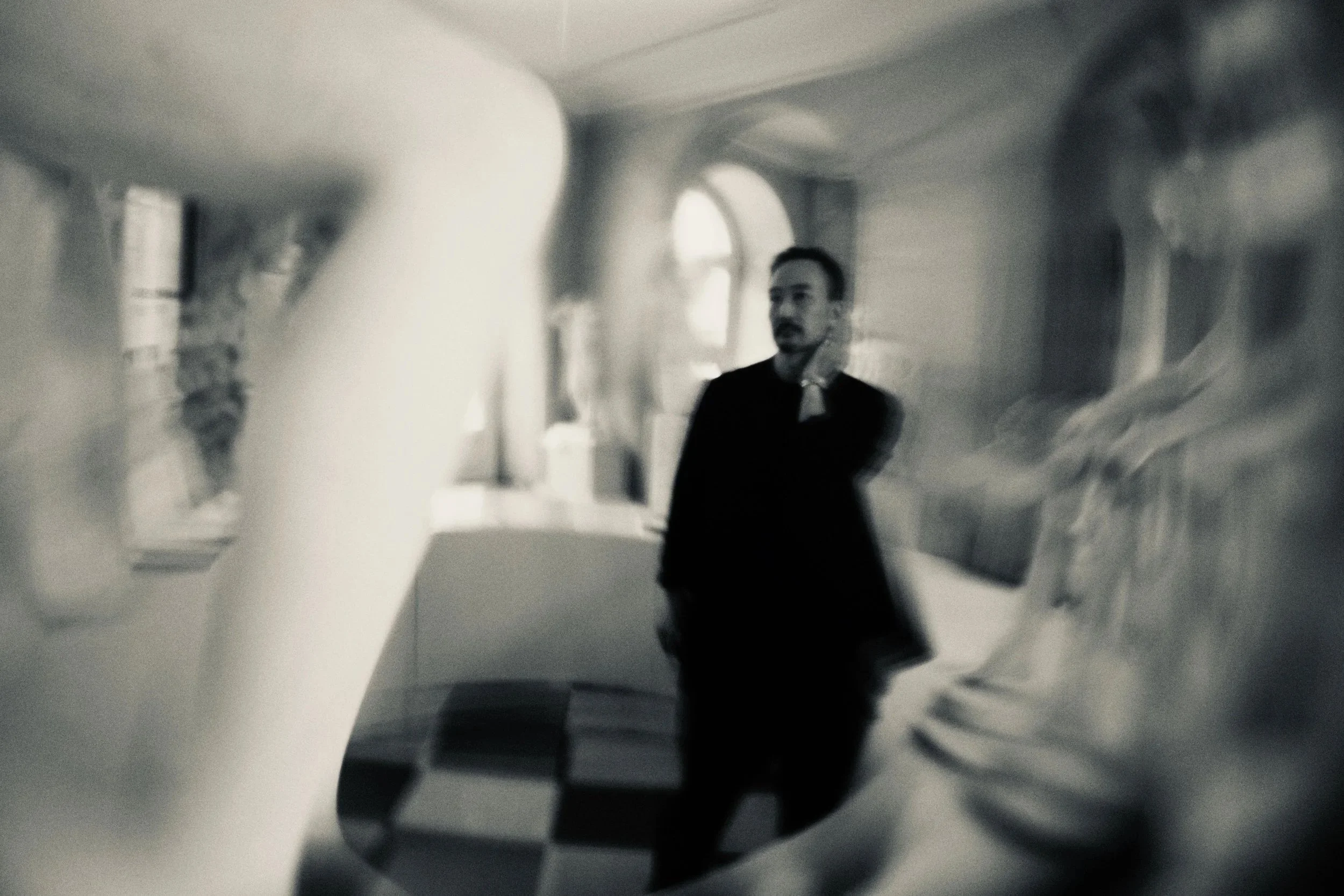
photo by camille blake
日本語/ Japanese
Echomatter
七年前、病院で母を看取った。”心臓が止まったあとも、数秒間は耳が聞こえていることがあります。どうぞ、話しかけてあげてください”、と看護師に言われた。僕は、母の耳元で「お母さん、ありがとうね」と何度か声をかけた。モルヒネで意識のない母に、僕の声が届いたのかどうかはわからない。
2年ほどたったある日、一度だけ、母が夢に現れた。それは夢というより、3秒にも満たない、ごく短い瞬間だった。前後の文脈は何もなく、ただ突然、「大変じゃない?」と生前のいつもの調子で話しかけられた。その声の質感があまりにもリアルで、全身が反応してベッドから飛び起きた。
声を耳で聴くものだと定義するなら、あの時僕が聞いたものは、声ではない。しかし、それは僕の延髄を直接震わせた。それは「もの」に近い感触をもっていた。
*
しばらくの間、僕はこの出来事を、ただの奇妙な夢として理解していた。だが、ある時から、それが単なる個人的な体験ではなく、芸術作品のなかで、繰り返し見かける一つのあり方──ある種のパターン──に近いのではないかと考えるようになった。
*
2024年の6月の終わり、レーベルのショーケースイベントでイタリアを訪れていた際、たまたま2度、オルフェウスの神話に接する機会があった。最初はヴェネツィアで見たJean Cocteauの映画「オルフェウス」で、次はミラノのFondazione Pradaで展示されていたゴダールの仕事場、《Le Studio d’Orphée》だ。もっとも、コクトーにも、オルフェウスという神話にも、それまで特段の興味を持ったことはない。しかし、映画『オルフェー』に描かれた Zone──冥界(underworld)として機能するその空間のアイデアに、僕は強く惹き込まれた。
それは、記憶や人間の習慣が物質へと変性し、廃墟として現れる空間だった。そこでは時間や因果の秩序が崩れ、生と死が同時に存在している。風が吹いていないのに、髪の毛が靡く。歩いていないのに、景色が進む。行為と結果が切り離されたその世界で、俳優の身振りは、ただ異様な運動として目に残る。しかし、その中で、出来事が起きているという感覚を、最もはっきりと残すのが声だ。誰かが喉を震わせ、肺の空気を押し出し、身体の内部を通過させて発せられたはずの声。それは生の痕跡で、体温だ。質量を持った何かだ。夢の中で聞いた母の声も、同じ性質を持っていた。
*
ミラノのプラダ財団では、スイスから移設されたゴダールのスタジオが《Le Studio d’Orphée》という名で常設展示されていた。ゴダールの名は、つい先週トリブーナでノートに書き留めたばかりだ。そしてここでも、オルフェウスが現れる。
機材の並ぶゴダールの私的な部屋を前にして、僕は考える。かつて映画を解体し、情緒的な物語を徹底して遠ざけたかに見えたゴダールが、なぜオルフェウスという典型的な神話にこれほど強く惹かれ、自分の仕事場にまでその名を冠したのか。
彼はこの部屋でひとり、編集機材とコンピュータを駆使して異なる音源を映像に衝突させていたに違いない。ベートーヴェンの弦楽四重奏、海鳥の鳴き声、爆撃の轟音、タイプライターの音、そして自身による乾いた朗読。オルフェウスが竪琴で岩や木々を動かしたように、ゴダールはミキサーのフェーダーを操り、これらの音を「聴くもの」から何か別のクオリティーへと変成させていたのではないか。音と映像を、単なる「視聴覚情報」から、別の位相へと転移させていたのではないか。
だとしたら、この部屋は、ただの編集室ではない。それは、彼が冥界へ降下し、何かを取り戻すのではなく、失うという行為を反復し続けるための装置だったのではないか。
*
ミラノからシカゴに戻る飛行機のなかで、僕はノートにメモをとる。
声が、記憶が、物質化する。
Echo Matter.
Spira Rococo del Echomatter
Rococo ∞ Echomatter